Showing posts with label protection. Show all posts

Monday, November 10, 2025

More Than Beasts of Burdens

I’ve always had a soft spot for donkeys. I can’t remember exactly when it started, but I do remember the first one I ever saw. It was standing in the middle of a field surrounded by five or six horses. While the others grazed together, that poor donkey stood off to the side, looking like it had wandered into the wrong party. I remember thinking, “Well, bless his heart—he must be so lonely.”

As a little girl, I figured the farmer had accidentally bought a donkey when he really meant to buy another horse. Later in life, I learned that the donkey wasn’t there by mistake at all. Turns out, farmers know a thing or two.

Donkeys are protectors. They’re not nearly as fearful as horses, and when a coyote or some other predator comes prowling around, that little gray guardian will bray, bite, and kick until the threat hightails it out of there.

You’ve got to love that kind of grit in such an unassuming package. A donkey doesn’t have the sleek beauty of a horse or the elegance of a deer—but it’s got backbone, and I think that’s part of what makes it special.

Another thing I’ve always found fascinating is that donkeys carry a dark cross across their backs and shoulders. Some say it’s just the way the hair grows, but I’ve always liked the story that after Jesus rode into Jerusalem on a donkey, every donkey born after that carried the mark of that sacred moment. Whether that’s true or not, it’s still a beautiful reminder of humility and service—the very things the donkey represents.

The Bible mentions donkeys quite a bit, and every time I read about one, I can’t help but smile. Abraham loaded a donkey with the supplies for his journey of faith. Balaam’s donkey saw an angel when its master couldn’t, and after being beaten three times, that poor animal finally spoke up—literally! I’ve known a few people who could learn a thing or two from that donkey about seeing what others can’t and knowing when to speak.

And then, of course, there’s Jesus’ triumphant entry into Jerusalem. He didn’t choose a chariot or a proud stallion. He chose a donkey—a symbol of peace. Kings rode horses into battle, but they rode donkeys when they came in peace. That says everything about the kind of King He is.

I suppose that’s why I’ve always admired donkeys. They may look plain, but they carry purpose. They don’t need fanfare or fancy saddles. They just quietly do their job—steady, dependable, and humble.

And maybe that’s what I want to be when people look at me someday—a little less like a show horse and a little more like a donkey. Faithful. Peaceful. Marked by the cross.

Heavenly Father, thank You for the lessons You tuck into the simplest of creatures. Help me to live like the donkey—faithful in service, steadfast in spirit, and willing to carry Your peace wherever You lead me. May others see the mark of the cross upon my life, not in words alone but in quiet acts of love and humility. Amen.

Random musings ©️ Bonnie Annis

Wednesday, November 16, 2022

Don't look back


It takes a lot of strength to walk away from something without looking back, believe me, I know. This is a lesson I've learned the hard way. The fixer in me always wants to make things right and that has caused me to often look back on people, places, and circumstances. 

In some instances, a brief look back was necessary to help me move forward, but in the majority of the cases, looking back only caused feelings of sadness, depression, or regret. And that's not a good thing. 

I was watching a made for TV movie series the other day. In one particular scene, a criminal is working hard to prepare a bomb. As he works to connect various wires and things to a complicated apparatus, the camera pans out revealing the dangerous explosive is being placed inside an innocuous looking suitcase. Later, as the show moves ahead, we see the criminal placing the bomb laden suitcase in a very public place, just at the corner of a building. As he walks away, he tucks a remote control into his pocket and as an evil smile crosses his face. Viewers can only imagine what comes next. Inevitably, a well-timed explosion will occur. Lives will be changed in a split second. Some will likely die, and others will suffer bodily injury. But will the perpetrator look back to witness the damage? The camera doesn't reveal those details. 

As I watched the show, I became engrossed. Sitting on the edge of my seat, biting my nails, I watched as one person and then another passed by the suitcase. None of the passersby paid attention to the abandoned luggage, and then, the screen goes into a tight shot. A small hand reaches down for the handle of the case just as the remote-control timer's numbers light up in red and we see the countdown begin, 03, 02, 01....

The next scene shows a crumpled little body amid a large pile of bricks and debris. Without having seen the event, one knows what happened. An evil intent had led to a malicious act which had, in turn, caused unnecessary, but permanent damage. It was nasty, heart wrenching stuff. 

Those kinds of show make for good entertainment, but in real life, it's a very different scenario. 

As I thought about the plot, I was reminded about a quotation popular artist, Mary Englebreit, once said, "Don't look back. You're not going that way." Wise words with intrinsic value. 

Another writer, Paul penned something more detailed in the book of Philippians of the Holy Bible. In chapter 3, verses 13- 14, he says: "Brethren, I count not myself to have apprehended: but this one thing I do, forgetting those things which are behind, and reaching forth unto those which are before, I press toward the mark for the prize of the high calling of God in Christ Jesus." He was reminding us the importance of remembering not only who we are and where we were going, but whose we are and why we are on the journey in the first place. 

It's easy to want to look back at devastating life events wondering why they happened and if there might have been anything we could have done to have prevented them but looking back on past events can't change them. It can only bring heartbreak and wondering. So why do we do it? 

There's an old saying, "Curiosity killed the cat." Not put that saying in context with the bomb incident I mentioned before and you'll get a clear picture. 

Often, God allows difficult and challenging things into our lives as part of His most excellent, perfect plan. Though we can't see or understand the entire picture at the time of the event, He knows exactly what is necessary to bring about the desired effects He chooses. 

Perhaps He will use a life altering event to help change our current course, moving us forward onto a better path. Though we may not understand, we must trust His Sovereignty. 

In almost 65 years of life, I've learned the importance of choosing not to look back. The lessons haven't always been easily learned. In the past, when I've glanced backward, I've often had to dodge a sharp piece of shrapnel, one of God's gentle reminders that I needed to leave well enough alone, to let bygones be bygones. When I've been obedient to walk away from dangerous or volatile situations, His hand of protection has covered me and guided me forward. When I've refused to heed His command and have chosen my own way, I've often been burned and have had to learn a very difficult lesson the hard way. 

I guess that's why He never gave us eyes in the backs of our heads. If He had, we'd constantly be looking backward! I'm thankful for His constant hedge of protection in my life. I hope you'll choose to keep your eyes forward, too. That way, you won't be tempted to glance back. Just remember, you aren't going that way. 

Friday, March 4, 2022

Cancerphobic

Every year, on our way to our favorite beach, we pass Eglin Air Force base. As we drive past, we're always looking to see which way the large radars are pointing and what the sign in front of the base shows regarding their security status level. We've passed when the radars were pointing west, pointing east, and pointing north. When they're tipped upward, we get concerned, especially if the security alert is on high. We know, if the status is high, there's danger. And while we're thankful our military is always watching; the public isn't always aware of impending danger. 

For the person touched by cancer, it seems our antenna are always on high alert. We're always watching and waiting. While we watch and wait and hope cancer never comes back, we know there's a real chance it could. We pay more attention to our bodies. Every ache, every pain, every random soreness could be an indicator that something needs attention. That's when we realize we've allowed ourselves to become cancerphobic. 

It's not a place we choose to be, it just is what it is. Cancer does a number on a person. It causes one to go into an anxious and high stress state. It doesn't feel good to know there are things that happen with our bodies over which we have absolutely no control. So, we find ourselves always on high alert. 

When two small spots popped up on my face last year, I wasn't overly concerned. I assumed they were from years of sun exposure. They were small and unobtrusive. I covered them easily with makeup, but when they began to grow and change color a bit, I started watching them. 

Years earlier, I'd had a small black melanoma removed from the top of my right hand. The doctor had done a punch biopsy to remove it and I'd had 3 stitches to close the wound, leaving a tiny star shaped symbol on my had. All of this had happened before my diagnosis with breast cancer. I knew how dangerous melanoma could be. I'd lost a high school friend to melanoma. He'd had a black mole on his back and thought it just an ugly mole. Within a few months, he was dead. That incident caused all of us to examine our bodies closely. Who would have thought a simple mole could be so deadly? 

The places on my face didn't look like melanomas to me. They weren't large. They weren't black. They didn't look bad, but they were there, and they didn't used to be. I didn't want to take a chance, so I contacted a dermatologist and went in for an exam. 

The dermatologist took a complete medical history on me and then began the physical exam. She had a specialized tool that would allow her to magnify and exam the spots in detail. After the exam, she said she didn't think they were cancerous but couldn't be sure without biopsies. With my history of cancer and my family's history, too, I asked her to go ahead and remove them. 

First, she gave me an injection of lidocaine to numb my face. Then, she began to use a tool to shave layer after layer of the places away. When she had removed the growths, she took a cautery tool and began to cauterize the surgical sites to prevent bleeding. As I sat in the chair smelling my own skin burning, it was odd. I was thankful she had the expertise to help, and I was thankful I was being proactive. 

I should receive the results of the biopsies in a week or so. I'm praying there's no evidence of any cancer. 

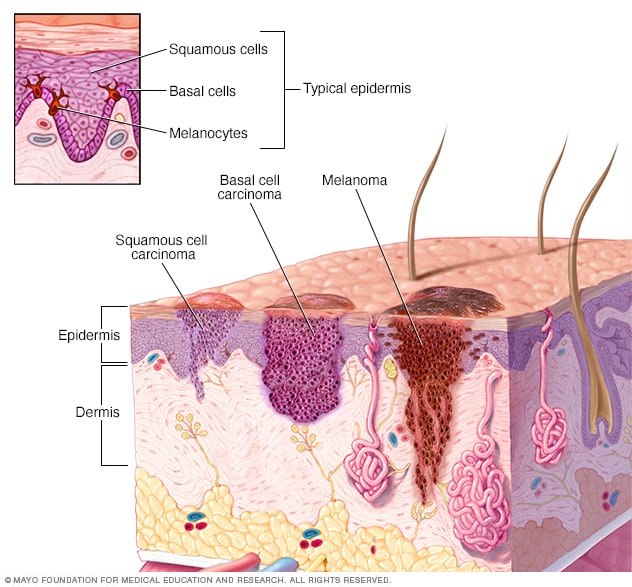
Melanomas can develop anywhere on your body. Most of the time, they develop on areas of the skin that have been exposed to the sun. Those areas include the face, arms, legs, and back. But they can also appear on other areas of the body, like the soles of your feet or under the nails. 

Normal moles are usually one color - tan, brown, or black. They usually have a uniform border and are usually smaller than a pencil eraser, but they can change over time. 

If you notice changes, remembering to look for the ABCDEs can help in your assessment: 

A represents asymmetrical shape. These moles are uneven and if you were to slice the mole in half, the sides would be very different in shape. 
B represents border. Moles with unusual borders may have characteristics of melanoma. Pay attention to scalloped or notched borders. 
C represents color. Moles come in all kinds of colors but are usually one color. If you find a mole with more than one color, or one with an uneven distribution of color, pay attention. This could be indicative of melanoma. 
D represents diameter. Any mole larger than a pencil eraser should be checked by a doctor. 
E represents evolving. Watch your moles. If they begin to change over time, there may be something wrong. Pay attention to the shape, size, and color. If the mole begins to bleed or itch, consult a doctor right away. 


Melanomas occurs when melanocytes become damaged. Those are cells that give color to your skin.

There are many ways the cells can become damaged. Exposure to tanning beds and excessive exposure to ultraviolet radiation are the most common causes of melanoma, but there are other risk factors. Those with very fair skin are at risk because they have less protection from damaging sun rays. Family history of melanoma can increase one's risk as well as a weakened immune system. 

The best way to protect your skin is to love it. Stay out of the sun during the hottest part of the day, usually between 10 a.m. and 4 p.m. When you are out in the sun, use a good quality sunscreen, preferably with an SPF of 30 or more. Sun damage can occur even on overcast days, so it's a good policy to use sunscreen any time you're outside. It's also important to reapply the sunscreen every couple of hours and apply it generously. 

It's normal for a person who's experienced cancer before to feel cancerphobic now and then. Cancer is a very serious and life altering condition, but a fear of recurrence shouldn't prevent one from enjoying the outdoors. Your skin is the largest organ on your body. It does so much for you - it protects you from germs, it helps regulate your body temperature, and is the first layer of defense from injury. Doesn't it deserve to be loved and taken care of? We only get one "body suit." I'm going to take good care of mine by watching it closely. How about you? 


People Watching at the Thrift Store

One of my favorite things to do is people-watch. There’s just something about observing people going about their day that reminds me how man...